mRNA offers an unusual combination of possibilities for therapeutic development. It can provide transient protein expression, replace or restore proteins, modulate pathways that are difficult to address with conventional drugs, and potentially allow the same underlying technology to be applied across very different diseases.
Those possibilities can also create a development problem. It is relatively easy for an early programme to become focused on what the technology can do: which constructs can be expressed, which formulations give the strongest signal, which animal models produce an effect. None of these necessarily establishes that the programme is progressing towards a viable medicine.
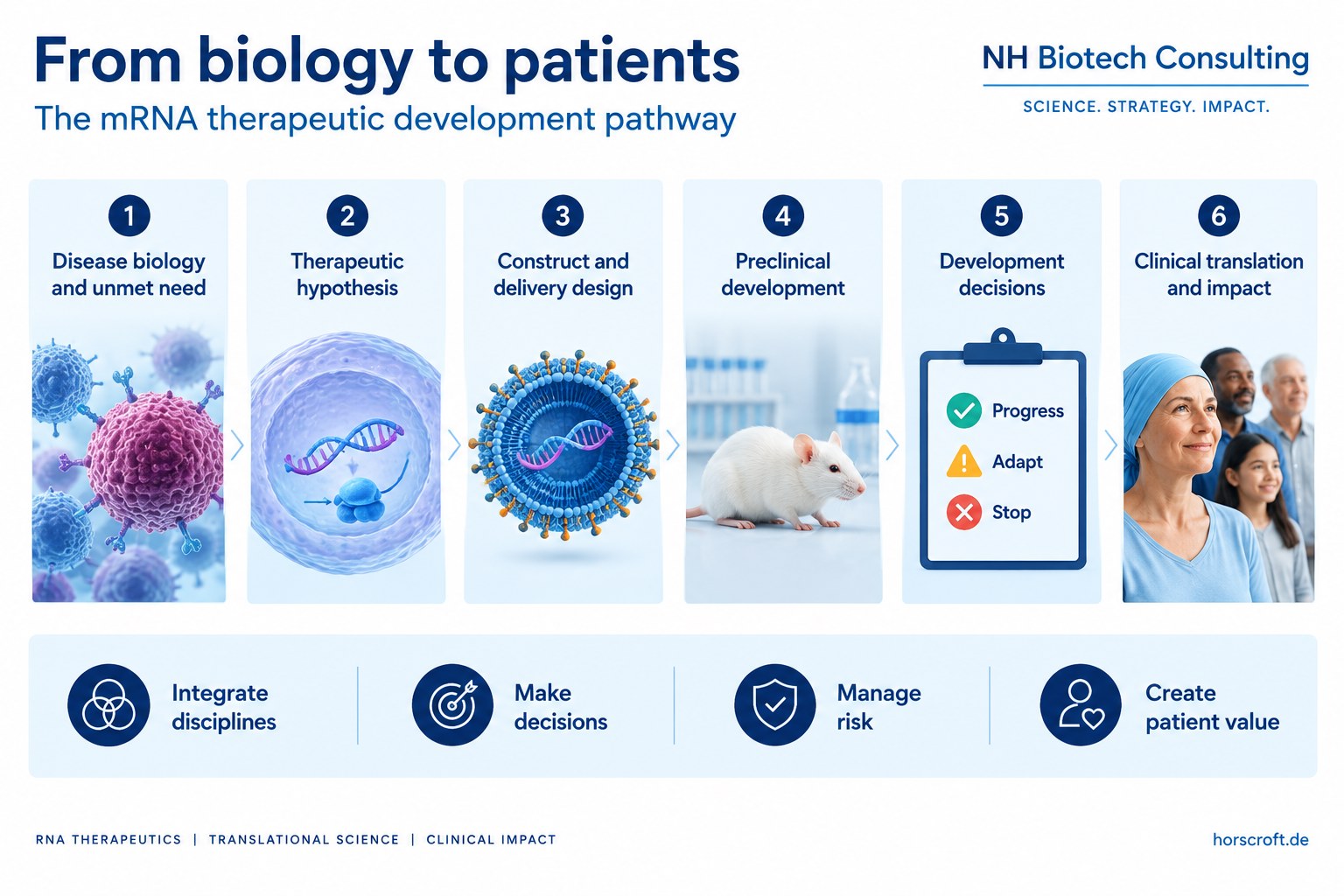
Across mRNA development, many of the most consequential risks arise at the interfaces between disciplines. Biology influences delivery requirements. Delivery influences the construct and dose. Construct and formulation choices affect manufacturability and tolerability. Preclinical models determine what can reasonably be inferred about clinical translation. Clinical trial design ultimately determines whether the therapeutic hypothesis has actually been tested.
The result is that apparently sensible decisions made within individual workstreams can collectively produce a weak development programme.
Start with the therapeutic hypothesis
One of the easiest traps in an mRNA programme is to start with the platform: what can we express, and where can we deliver it?
A more useful starting point is the disease biology. Which cells need to be affected? What protein or pathway needs to change? How much expression is likely to be required? How long should it persist? What biological response would indicate that the therapeutic mechanism is working?
These questions sound obvious, but they have practical consequences throughout development. Showing that an mRNA produces protein is necessary, but expression itself is not pharmacology. The relevant question is whether expression occurs in the appropriate cells, at sufficient magnitude and duration, and changes disease-relevant biology.
An example from work in which I was involved illustrates the distinction. In a liver fibrosis programme, HNF4A mRNA was delivered using hepatocyte-targeted lipid nanoparticles. The development question was not simply whether mRNA could be delivered to the liver. The hypothesis was that restoring HNF4A activity in hepatocytes could restore aspects of hepatocyte function and influence fibrosis-associated biology.
The resulting studies connected delivery and HNF4A expression with mechanistic and disease-relevant effects. PON1 was identified as one mediator of the antifibrotic effect, while changes were also observed in macrophage infiltration and polarisation, hepatic stellate-cell activation and fibrosis across multiple models (Yang et al., 2021, PMID: 34453962).
The important point is the structure of the evidence. Delivery, expression, mechanism and disease-relevant pharmacology were connected. That therapeutic hypothesis then determines what models, biomarkers and experiments are useful.
Construct and delivery cannot be optimised independently
Once the therapeutic requirement is defined, construct optimisation can begin. Here another apparently straightforward objective can cause problems: maximising expression.
The highest-expressing construct is not necessarily the best therapeutic construct. Different programmes may require rapid expression, prolonged expression, relatively modest expression, repeated administration or tight control over innate immune activation. The relevant optimisation objective depends on the intended medicine.
Delivery has the same problem. A formulation that performs well in one programme cannot be assumed to be appropriate for another simply because it delivers mRNA efficiently. Route of administration, tissue exposure, target-cell uptake, the fraction of cells that must be reached, off-target expression, tolerability and repeat dosing can all alter the requirements.
This becomes particularly important when selecting between established and novel delivery technologies. An established LNP may bring greater manufacturing and regulatory experience and a more developed preclinical package. A novel lipid or targeting approach may offer better performance or differentiation, but can introduce additional development risk, analytical requirements, manufacturing work and cost.
For a smaller biotech, the best-performing formulation in a screening experiment therefore may not be the best development choice. The relevant comparison is the risk-reward profile for that programme, at that stage, with the available capital and development timeline.
CMC belongs in this discussion much earlier than it sometimes appears. RNA length and sequence, purity, formulation, encapsulation, stability, analytical methods and scale-up are influenced by decisions made during discovery. Treating construct optimisation, delivery selection and manufacturing development as consecutive activities can create substantial rework.
They are better considered as parts of the same product-design problem.
Preclinical development should reduce uncertainty
Once a candidate begins to emerge, there is a natural tendency to accumulate evidence around it. More experiments, however, do not necessarily produce greater confidence.
A useful preclinical programme should answer a series of different questions:
Delivery → expression/engagement → mechanism → pharmacology → disease modification
No single model necessarily needs to answer all of them.
A model may be familiar, reproducible and widely used in a particular disease area while still being poorly suited to the most important uncertainty facing the programme. Conversely, a model with obvious limitations may be extremely useful if it answers one specific translational question well.
Biodistribution illustrates the problem. Detecting mRNA or encoded protein in an organ demonstrates exposure at some level, but it does not necessarily demonstrate therapeutic delivery. The relevant cell population must receive enough mRNA to produce the required expression for long enough to support the intended pharmacology.
The same discipline should apply to biomarkers. Biomarkers should help determine whether the product reached the appropriate cells, whether the protein was expressed, whether the expected mechanism was engaged, whether downstream biology changed, or whether the programme should progress. A large biomarker panel can produce an impressive dataset while leaving the central therapeutic question unresolved.
This is also where experimental design becomes important. For studies that will influence major development decisions, endpoints, sample size, randomisation, blinding, exclusions and statistical analysis should be considered before the data are generated. Statistical significance alone is insufficient. Effect size, confidence intervals, reproducibility, biological relevance and translational confidence all contribute to whether a result supports progression.
There is another practical consideration for smaller companies. Some experiments exist primarily to make a development decision. Others may eventually support regulatory interactions, publication, partnering or financing. If a study is likely to carry several of these functions, additional controls, orthogonal methods or mechanistic experiments may be worth incorporating from the beginning rather than trying to reconstruct the evidence later.
Before commissioning an important experiment, one question is particularly useful: What decision could this result change?
If none of the plausible outcomes would alter the programme, it is worth asking whether that experiment is currently the best use of time and resources.
Strategy is a sequence of decisions
Strong science does not automatically create a viable development programme. This becomes particularly apparent in smaller biotechs, where decisions have to be made with limited capital, incomplete evidence and substantial dependence on external organisations.
Programmes can easily become activity-driven. Studies are initiated because they are scientifically interesting, conventionally expected, already budgeted or simply next on the project plan. A development strategy should instead define what must be demonstrated next, which uncertainty is currently most important, what evidence is essential and what can wait.
This also means being selective about optionality. Maintaining several constructs, formulations, indications or development routes can initially reduce risk. Keeping all of them alive for too long can do the opposite, spreading resources across alternatives while preventing the strongest programme from receiving sufficient attention.
Optionality is most useful when each option has a purpose, a decision point and an expiry date.
The same principle applies to the critical path. The scientifically most interesting activity is not necessarily the one controlling the development timeline. Manufacturing slots, analytical methods, material availability, toxicology planning, regulatory preparation or contracting can become rate-limiting. The critical path therefore needs to be revisited as the programme evolves.
Outsourcing does not remove this responsibility. CROs, CDMOs and specialist consultants can give a small biotech access to capabilities it could never efficiently build internally, but someone within or acting for the company still needs sufficient technical oversight to challenge assumptions, identify inconsistent results and integrate evidence across workstreams.
Externalised R&D still requires internal scientific leadership.
Define success before seeing the result
One of the harder development disciplines is deciding in advance what constitutes sufficient evidence.
If success criteria are vague, an ambiguous result can easily generate another experiment. When that experiment is also inconclusive, another follows. Over time, the programme can consume substantial resources without materially changing the original uncertainty.
Predefined criteria do not eliminate scientific judgement. They make explicit what the team believed before seeing the result.
This becomes particularly important when the first clinical asset is also expected to validate a broader platform. A weak result from that programme can threaten assumptions underlying later pipeline assets, financing plans and partnering discussions. That creates a powerful incentive to preserve the lead programme.
The resulting question can become distorted. Instead of asking whether the asset still has a credible development case, the organisation begins asking what additional evidence might allow it to continue.
At that point it is useful to separate the asset from the platform. What exactly was the lead programme intended to validate? Could that question be answered through another asset or indication? Are subsequent programmes genuinely dependent upon the lead result? Would the remaining capital create more value by continuing the programme, changing direction or narrowing the platform claim?
Stopping an asset does not erase the knowledge generated from it. Data, intellectual property, manufacturing capability, platform knowledge and validated assays may retain considerable value. Continuing a programme without a credible route forward can destroy more of that value than a disciplined stop decision.
The clinic should test the therapeutic hypothesis
The transition into clinical development brings these strands together.
Two established drug-development frameworks are useful here. AstraZeneca’s 5Rs framework describes five determinants of programme quality: the right target, right tissue, right safety, right patient and right commercial potential (Cook et al., 2014, PMID: 24833294). Pfizer’s Three Pillars focus more specifically on whether a mechanism has actually been tested in humans: exposure at the site of action, target engagement and evidence of the expected pharmacological effect (Morgan et al., 2012, PMID: 22227532).
Neither framework was developed specifically for mRNA therapeutics, but both raise useful questions for the modality.
For an mRNA product, exposure is more complicated than the presence of material in plasma or an organ. The formulation must distribute appropriately, the relevant cells must take it up, mRNA must become available intracellularly, functional protein must be produced, and expression must persist for an appropriate period. Depending on the therapeutic mechanism, some of these steps may be directly measurable in patients and others may not.
Dose selection therefore also has to connect toxicology with pharmacology. Toxicology can establish an acceptable starting point or safety boundary, but an informative clinical programme needs a realistic prospect of reaching a dose capable of testing the therapeutic mechanism.
Patient selection can be equally important. Disease stage, residual tissue function, target expression, previous treatment, heterogeneity and reversibility can all affect the probability of observing an early clinical signal. A convenient population for recruitment is not necessarily the population that provides the clearest test of the hypothesis.
Biomarkers should again be selected around the principal uncertainties. Did sufficient delivery occur? Was the encoded protein produced? Was the pathway affected? Was the biological response large enough to be relevant? Can differences between responders and non-responders be interpreted?
The importance of this is illustrated by Pfizer’s analysis of 44 programmes reaching Phase II decision points. In 43% of cases, the available evidence did not allow the investigators to determine whether the mechanism had been adequately tested (Morgan et al., 2012, PMID: 22227532).
A negative clinical result is considerably more useful when the programme can establish what was actually tested.
From a platform to a medicine
The recurring theme across these pitfalls is integration.
Disease biology should determine the therapeutic hypothesis. That hypothesis should define the cells that need to be reached and the expression profile required. Those requirements inform construct and delivery choices, which in turn have consequences for safety, CMC and clinical feasibility. Preclinical studies should then reduce the uncertainties that determine whether progression is justified, and the early clinical programme should provide an interpretable test of the resulting hypothesis.
Before progressing an mRNA therapeutic programme, I would want reasonably clear answers to ten questions:
- What disease biology are we trying to change?
- Which cells need to express the encoded protein?
- How much expression is required, and for how long?
- Can the proposed delivery system plausibly achieve that?
- Can the resulting product be manufactured and controlled appropriately?
- What is the largest unresolved uncertainty in the programme?
- Does each major planned experiment address a development decision?
- What results would support progression, adaptation or stopping?
- Can the clinical study establish whether the therapeutic mechanism has been adequately tested?
- If the biology works, does the intended product have a credible clinical role?
An mRNA platform can create possibilities. A development programme has to progressively narrow those possibilities into a medicine that can be manufactured, administered, tested and, ultimately, provide a meaningful benefit to patients.
That requires more than demonstrating that the technology works. It requires knowing which uncertainties need to be resolved, generating evidence that resolves them, and being prepared to act on the answer.