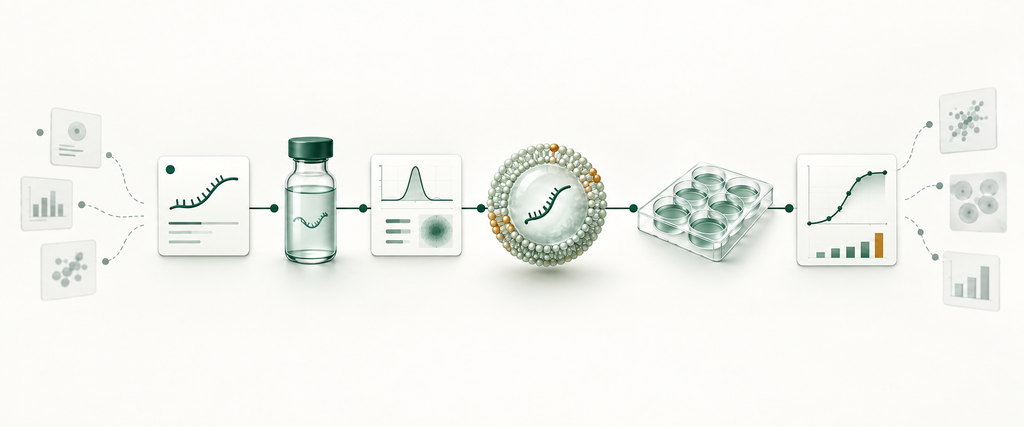
AI can help mRNA teams prioritise sequences, formulations and experiments. Its value depends on whether every result can be connected to the material tested and the conditions under which it was measured.
Artificial intelligence has become a familiar part of the mRNA-development conversation. Companies describe tools for sequence design, antigen selection, ionisable-lipid discovery, formulation optimisation and interpretation of complex experimental data. The promise is appealing: fewer low-value experiments, broader exploration of design space and faster selection of development candidates.
The more useful question comes earlier. When an mRNA programme records a result, does it preserve enough information for a later team, programme or model to interpret the material and experimental conditions that produced it?
A dataset is worth learning from when the identity of the material, its processing history, the biological experiment and the resulting measurement can be reconstructed well enough to distinguish the variables that plausibly accompanied the result. In mRNA development, that requires a view of the whole product rather than an isolated sequence or endpoint value.
For this article, AI includes machine-learning prediction, computational sequence optimisation, generative methods and decision-support systems that learn from accumulated experimental data. They have different technical requirements, but each depends on a clear definition of the decision it is intended to support and credible experimental evidence.
The traceable product and experiment are the unit of learning
An expression or potency value is measured on a particular mRNA product in a particular experiment. It reflects the construct and RNA-quality state, the LNP and process used to make it, the analytical condition of the material, and the dose, biological system, time point and assay used for measurement. Those details determine whether a result can support a later decision beyond the immediate study.
The development lineage should therefore remain visible:
Construct version → RNA batch → RNA-quality state → LNP batch → test article → biological experiment → assay/sample → result
This can appear self-evident when a programme is small and the same people are present for each decision. It becomes much less secure after several construct revisions, a technology transfer to a CDMO, formulation work at another partner and in-vivo studies in a separate system. Each group may keep good records, while the relationships between records become difficult to reconstruct.
Consider a result reported as higher potency. It may coincide with a revised UTR, lower residual double-stranded RNA, a different lipid lot, a changed N:P ratio, a shift in particle size, a revised cell assay or a longer interval between formulation and testing. Without linked identities, material attributes and experimental conditions, the result may guide an immediate project decision but contribute little reusable knowledge.
This is closely aligned with two established development disciplines. FAIR data principles emphasise persistent identifiers, rich metadata and interoperability for reuse in biopharmaceutical R&D (PMID: 30690198). Quality-by-design and CMC thinking connect material attributes, process parameters, quality attributes and performance. AI readiness extends those disciplines into a data system that can support repeated technical decisions.
Three conditions for data that can be reused
1. Data completeness
The relevant variables need to be recorded. For mRNA-LNP work, that commonly includes construct architecture and chemistry; RNA production, purification, integrity and impurity data; lipid identities and ratios; mixing conditions; particle attributes; dose, route and biological model; assay method; and sampling time point. The precise fields will vary with the development question, but an incomplete record limits later interpretation.
2. Linkage and provenance
Those fields must be linked unambiguously. A shared folder of reports is useful for document control, yet it does not provide a shared data model. Persistent identifiers connect the construct, RNA batch, LNP batch, test article, experiment and measurement, allowing a later reviewer to trace the actual material behind a result.
3. Experimental identifiability
Good metadata cannot resolve an experiment whose variables are inseparable. If every new sequence is tested in one LNP and each alternative LNP carries a different payload, a model cannot readily distinguish sequence effects from formulation effects. Confounding, batch effects and site effects should be considered when the study is designed, rather than discovered after data have accumulated.
Recent discussion of mRNA-LNP CMC similarly frames translation around linked material attributes, process parameters, quality attributes and biological performance (PMID: 42593721). This is the product context a development dataset must preserve.
| Entity | Persistent identity | Critical context |
|---|---|---|
| Construct | Construct ID and version | CDS, UTRs, cap design, poly(A), modified nucleosides |
| RNA material | RNA batch ID | IVT and purification process, integrity, impurities, storage |
| Formulation | LNP batch ID | Lipid identities and lots, ratios, N:P, mixing conditions |
| Test article | Material ID | Concentration, particle attributes, age and storage state |
| Experiment | Study or experiment ID | Model, dose, route, controls and sampling time |
| Measurement | Assay or sample ID | Method version, processing, raw and normalised values, QC and deviations |
Design experiments that can teach the programme something
Dataset size is often a poor proxy for usefulness. Experimental diversity becomes valuable when its sources are interpretable. A study of 213 LNPs used 314 formulation and structural features to train random-forest models of intradermal mRNA expression in mice (PMID: 39264000). Its results are informative within the chemistries, payloads, process conditions, route and biological system represented in those experiments: the model’s domain of applicability.
The same principle is visible in LinearDesign, which addressed a defined sequence-design problem by jointly optimising codon usage and predicted RNA folding stability, followed by experimental evaluation of selected designs (PMID: 37130545). It illustrates the value of a defined computational objective linked to a specified experimental validation plan.
Reference materials are a practical way to make a programme more learnable. A stable benchmark construct or benchmark LNP carried across campaigns provides a statistical bridge between studies, sites and time periods. It helps distinguish a genuine product effect from a shift in assay performance, material handling or biological model.
Valid negative results deserve the same provenance as successful ones. Inconclusive experiments should also be retained, with an explicit reason for their status. A formulation that performs poorly despite valid quality control and controls can define an important boundary condition. An assay invalidated by failed controls or uncertain material identity should be recognisable as such rather than absorbed uncritically into a training set.
Validation requires the same discipline. A random train-test split can place closely related observations on both sides of the comparison: replicate samples from one LNP batch, highly similar sequence variants, measurements from the same campaign or repeated observations on the same material. This validation leakage can make a model look more reliable than it is. Grouped validation by batch, construct family or campaign, followed by prospective testing on new materials, gives a more realistic assessment of whether the model will help the next development decision.
Four public examples of learning infrastructure in mRNA
The following disclosures are illustrative rather than a market comparison. They show different ways in which companies are connecting computation with experimental evidence; public materials reveal only selected details of the underlying datasets and performance.
- Design-to-build integration. Moderna describes its mRNA Design Studio as a proprietary suite that takes a protein target through mRNA sequence design and into automated, high-throughput preclinical production (Moderna). The relevant lesson is the link between the proposed construct and a traceable experimental workflow.
- Proprietary formulation history. Sanofi has described models trained on its internal LNP library to prioritise particles for further evaluation. The public information does not permit an assessment of training-data composition or prospective performance, but it illustrates a focused decision-support use case.
- Automated design-build-test-learn infrastructure. Abogen states that it combines AI-supported mRNA sequence design, automated mRNA synthesis and quality control, an AI-driven ionisable-lipid library and a lipid-structure database (Abogen). These remain company disclosures, while showing that such infrastructure is also being developed in China.
- Purpose-built training data. Therna describes Chronos as an experimental data engine for its AI RNA work and links it to a peer-reviewed, massively parallel synthetic-gene atlas across cellular contexts (Therna). Deliberately designed experimental matrices can yield more transferable evidence than heterogeneous historical records.
A minimum viable learning system for smaller companies
Few emerging mRNA companies can build a large internal design-and-automation platform. They can still establish a development system that improves technical judgement immediately and becomes more useful as programmes progress.
Public tools can assist sequence generation and prioritisation. LinearDesign is a well-known openly described approach. Public formulation models and data resources can also help define a starting set of experiments. Their output is best treated as a hypothesis in the intended product context, because the training chemistry, payload, process, assay and biological model may differ materially from the programme’s own system.
A practical minimum viable learning system has three elements:
- Define lineage. Assign persistent identities to construct versions, RNA batches, LNP batches, test articles and experiments, with explicit links between them.
- Standardise context. Set a concise mandatory metadata record, include structured data-return requirements in CDMO and CRO scopes of work, and retain raw data where practicable alongside processed results.
- Design for learning. Carry benchmark materials across campaigns, vary selected factors in ways that reduce confounding, retain valid negative results and plan grouped and prospective validation.
This does not require a bespoke AI platform or a large data-science team. It creates a coherent dataset that supports human review, statistical analysis and more sophisticated modelling when the programme is ready.
It also provides a useful way to assess an offering described as AI-enabled. A polished interface around public tools may support literature review, data organisation or candidate generation. The relevant diligence questions are practical: Which development decision does it support? What evidence informs the output? Does it incorporate the company’s own experiments? Has it been prospectively tested on relevant products? Can the result be traced to the underlying material and experimental context? Who owns the resulting data and any trained model?
Clear answers do not require disclosure of proprietary algorithms. They do show whether a tool is likely to strengthen a real development decision.
The first practical investment
The near-term opportunity for AI in mRNA development is better decision support: choosing a more informative experiment, recognising inconsistencies, prioritising a manageable set of construct-formulation combinations and identifying potential CMC risks earlier. A linked, well-described dataset also improves oversight of external partners and reduces time spent resolving basic questions of identity and comparability.
The programmes most likely to benefit will be able to follow each design choice through RNA manufacture, formulation, analytical characterisation and biological performance. For many mRNA teams, the first AI investment is making sure that tomorrow’s team can reconstruct exactly what today’s experiment tested.